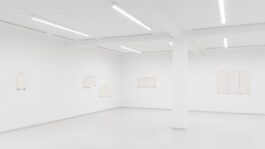
Hands, gestures, poses. ihsan saad ihsan tahir’s exhibition at O—Overgaden reflects how depictions of Arab bodies have been continuously feared and desired, appropriated and exploited—not unlike artworks or artefacts—by quoting ancient sculpting formats while reiterating these in contemporary industrial materials.
The exhibition title TH8 BJIBK is Arabizi for the expression “trust your pockets.” Arabizi is an informal writing system invented in response to the lack of Arabic characters on early smartphones, and it remains widely used in popular media, for instance in song titles. It is also dialect-specific, with no official governing rules; a living language of street culture. The title thus points to how Arab culture can carve out a space in a Western-dominated world—
and what rules, translations, and signs this produces. “Trust your pockets,” beyond literally meaning “trust what you have in your pockets,” can mean “trust your own currency” or “trust your own value.” In this way, it opens up a discussion about valuation and ownership: Which bodies and postures are depicted on the friezes of the past as well as the present?
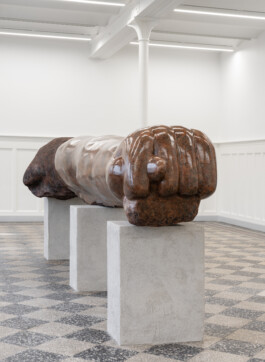
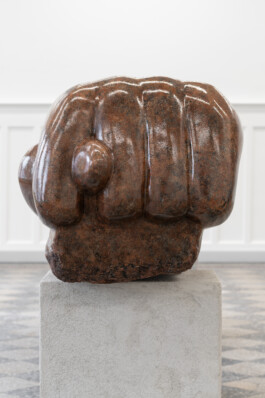
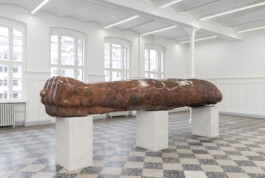
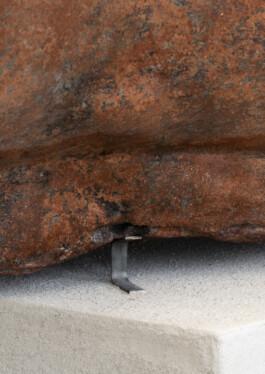
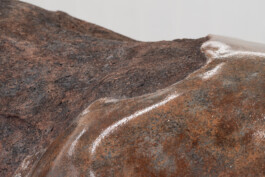
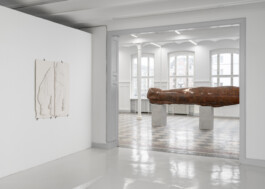
A centerpiece at O—Overgaden is a styrofoam and jesmonite reconstruction of the colossal granite arm of Pharaoh Amenhotep III with clenched fist, expropriated to the British Museum. To this tahir adds a manus fica, a historic gesture where the thumb is pushed between index and middle finger. The hand sign carries multiple meanings: Historically it was used in the Mediterranean region to distract and ward off the evil eye and other curses; in present-day Denmark it is used among families with children to signal “I’ve stolen your nose.” Meanwhile in contemporary street culture it is employed as an explicit insult; and here in the work, it signals protest or revolt—a resistance to the colonial theft the sculpture embodies, one that points directly to the current discussion around the national belonging of historical artworks and artefacts, and calls for repatriation
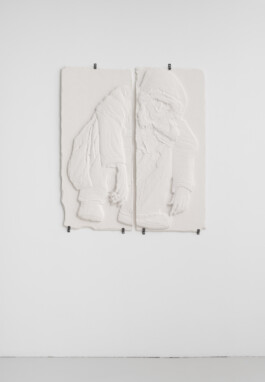
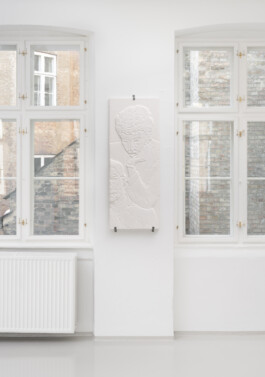
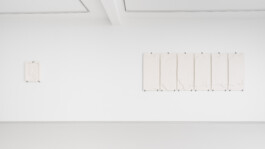
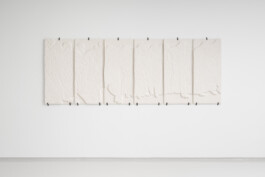
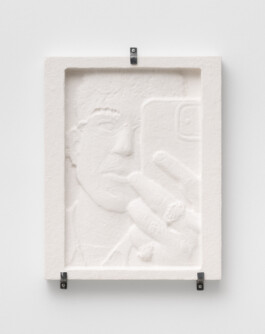
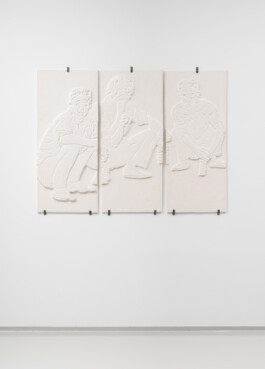
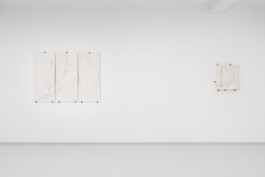
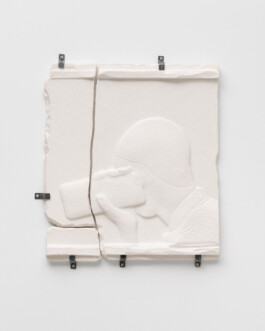
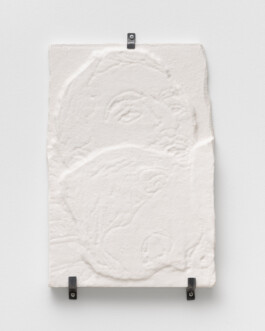
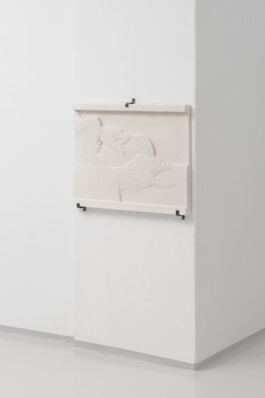
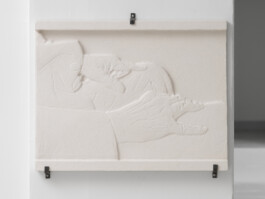
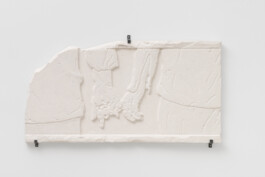
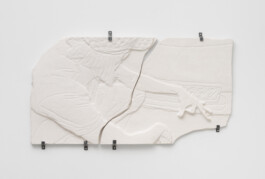
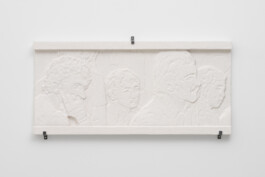
Alongside this sculpture, a series of reliefs employs the artist’s roots in a dual fashion. On the one hand the panels formally reference the Assyrian friezes of Northern Iraq. On the other hand, their imagery is a combination of tahir’s private photo archive—a group of his male family members, a selfie, a caress between his father and brother—and found images of Arab men, including, among other scenes, a gangster-like character posing in front of a car as well as a
large-scale frieze in which it is unclear if the figures are celebrating or fighting.
Resonating with the Pharaoh’s clenched fist, hands are a dominant motif: gesturing, praying, holding a phone, caressing. Carved in polyurethane foam with a surface imitating sandstone, the reliefs’ soft, almost vanishing contours ask for an intimate, close-up viewing, that helps to destabilize the stereotypical framing of the Arab male body as combative or aggressive, while pointing to a different, soft masculinity of mutuality and care.